By Gaurang Shah
A seller sat across from me a few months back with a semi-detached in hand and a detached house in his sights. His first question wasn’t about staging or timing. It was simpler than that: “How much am I actually going to have in my pocket?” He didn’t have a number for the sale price yet, let alone what would come off it. And the number he really needed wasn’t the sale price at all. It was what he’d have left to put toward the upgrade.
My read: that’s the question every move-up seller should be asking first, and most people ask it backwards. They price the next house before they know what the current one actually nets them.
Here’s what made his situation specific. He wasn’t just selling. He was trading up, semi-detached to detached, which meant every dollar that leaked out in commission, discharge fees, or a penalty he hadn’t accounted for was a dollar that didn’t make it into the next down payment. For a seller in that position, closing costs aren’t background noise. They’re the difference between the upgrade working on paper and not.
A Brampton or Mississauga homeowner selling to move up, who needs to know what actually lands in their account before they can commit to the next purchase.
Seller closing costs in Ontario typically include commission plus HST, legal fees, mortgage payoff, any discharge fee or prepayment penalty, and applicable adjustments. What’s left after all of that is your net proceeds, the money that actually lands in your account. Land transfer tax is a buyer cost, not a seller cost, so it never comes off your side. For a seller trading up, that net number isn’t just what you keep. It’s what you have to work with on the next house.
HST treatment of commissions, mortgage discharge and prepayment penalty rules, and condo status certificate fees below are current as of this review. Confirm your specific mortgage penalty and legal fees directly with your lender and lawyer, since these vary by contract and firm.
The Net Proceeds Table: What It Actually Looks Like
Seller closing costs in Ontario aren’t one fee. They’re a list, and most sellers have only priced in one line of it: commission.
This is where I ask every seller the same question: have you seen the actual list of deductions, or just guessed at commission? Guessing is how the gap between expectation and reality gets big enough to change someone’s plans, and for a seller trading up, that gap lands directly on the down payment for the next house.
Here’s the full list, in the order it typically appears on your lawyer’s closing breakdown (called the Statement of Adjustments):
| Deduction | What it is |
|---|---|
| Real estate commission + HST | Commission is negotiable and set between you and your brokerage. It’s subject to HST, which applies even though the sale of a resale home itself is usually HST-exempt. |
| Mortgage payoff | The remaining balance owed on your mortgage, paid out directly from the sale proceeds at closing. |
| Mortgage discharge fee | A fee your lender charges to formally release the mortgage from title. Federally regulated lenders are required to disclose this fee in your mortgage contract. |
| Mortgage prepayment penalty | Only applies if you’re paying off a closed mortgage before the end of its term. This can be one of the largest and most underestimated costs on this whole list. |
| Legal fees and disbursements | Your real estate lawyer’s fee for closing the sale, plus disbursements (extra costs like title searches and the discharge registration itself). |
| Property tax adjustment | If you’ve prepaid property taxes past your closing date, the buyer reimburses you for the overlap. If you’re behind, it comes off your proceeds instead. |
| Utility adjustment (where applicable) | Prepaid municipal utility accounts are divided based on the closing date, the same way as property taxes, adjusted between buyer and seller. |
| Status certificate fee (condo only) | Ontario caps this fee at up to $100 including tax. Who pays it, buyer or seller, can vary by agreement, so confirm with your lawyer. |
What this means: the sale price is the top of a list, not the number you plan around. Everything below commission is a direct subtraction, and two of those lines, the mortgage penalty and the discharge fee, are the ones sellers most often forget to check before they list.
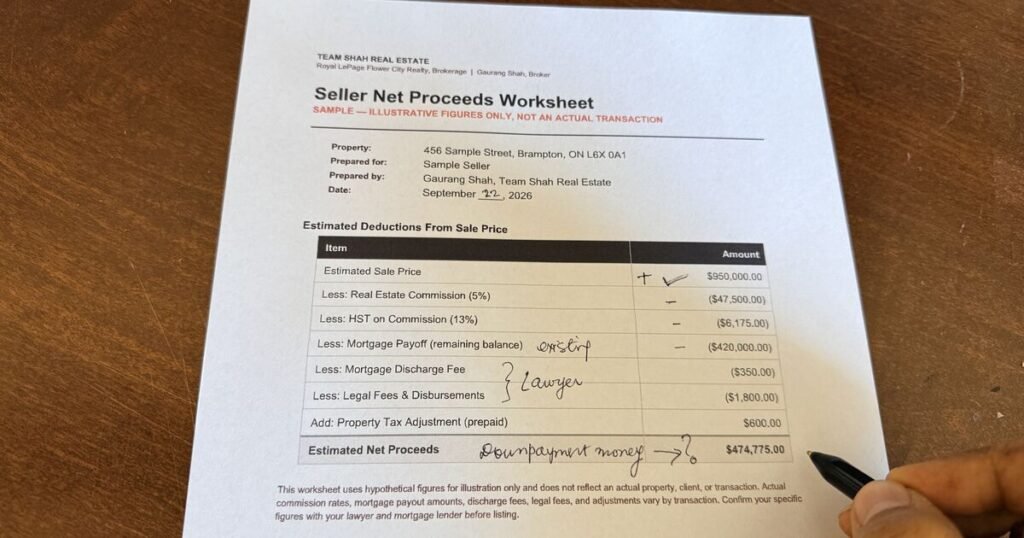
This is a made-up scenario to show how the math actually stacks, not a projection for any specific sale. Say a semi-detached home sells for $950,000, with a 5% commission and a remaining mortgage balance of $420,000 at closing:
- Sale price: $950,000
- Commission (5% + HST): -$53,675
- Mortgage payoff: -$420,000
- Mortgage discharge fee: -$350
- Legal fees and disbursements: -$1,800
- Property tax adjustment (prepaid): +$600
- Estimated net proceeds: approximately $474,775
Your own numbers will look different depending on your commission rate, mortgage balance, and mortgage terms. This example exists to show how the deductions stack, not to predict your result.
The Cost Most Sellers Never See Coming
Here’s a pattern I see constantly, and it’s not about carelessness. It’s about which number is easier to find.
If you’re selling while still under a closed mortgage term, breaking that mortgage early can trigger a prepayment penalty, and it can genuinely cost thousands of dollars.
The Financial Consumer Agency of Canada’s guidance on prepayment penalties and on mortgage discharge fees both confirm that lenders must disclose these costs in your mortgage contract. But “disclosed in a contract you signed years ago” and “top of mind when you’re planning a sale” are two very different things.
Before deciding to sell because the market feels right or the payment jumped, check your penalty first. The sale price is not the number that tells you whether selling now makes financial sense. The number that matters is what’s left after the mortgage payoff, the discharge fee, and the penalty, if there is one, come off the top.
The upside of knowing this number early is that it changes your timeline intelligently. Maybe you wait for your term to end, maybe the penalty is small enough that it doesn’t matter. The trade-off is that finding it out requires a phone call to your lender before you list, not after you’ve already accepted an offer.
Land Transfer Tax Is Not Your Problem
This one’s simple, and it’s worth stating plainly because it comes up constantly at listing appointments: land transfer tax is not one of your seller closing costs. It’s paid by the buyer, not the seller. It has nothing to do with your net proceeds. If you’re doing rough math on what you’ll walk away with and land transfer tax shows up anywhere in that math, take it back out. It belongs on the other side of the transaction entirely.
Condo Sellers: One More Line Item
If you’re selling a condo, add one thing to the list above: the status certificate. Your buyer’s lawyer will request it, and the condominium corporation prepares it. In Ontario, the Condominium Authority of Ontario caps this fee at up to $100 including tax, with a 10-day delivery window. Who actually pays it, buyer or seller, isn’t fixed by law and can vary by agreement, so confirm this specifically with your lawyer rather than assuming it comes off your proceeds automatically.
What This Estimate Doesn’t Cover
Everything above deals with the costs and adjustments that come off your sale price at closing. It does not address income tax consequences, including capital gains, especially if the property wasn’t your principal residence for the entire time you owned it, or if part of it was rented out, such as a basement apartment. Those are separate calculations from your lawyer’s Statement of Adjustments, and they’re worth confirming with an accountant before you list, not after the proceeds are already spoken for. See the CRA’s guidance on principal residence and other real estate for the rules that apply to your situation.
Before You List, Confirm:
- Your current mortgage discharge fee, in writing from your lender
- Whether you’re still inside a closed term, and what the prepayment penalty would be if so
- Your lawyer’s quoted fee for a standard sale closing
- Your property tax account status, prepaid or behind
- If applicable, that your condo corporation’s status certificate turnaround won’t hold up closing
A seller who’s already confirmed their closing costs walks into a listing appointment as a genuinely prepared client. It also means when we talk, we’re talking about strategy, not discovering basic numbers for the first time.
Want to See Your Actual Net Number Before You List?
Rough math on a napkin is how the gap between expectation and reality gets wide enough to change your plans. Run your specific numbers through our seller net proceeds calculator (Seller Net Sheet Calculator), or if you’re in Mississauga specifically, see how this played out in real terms in How Much Will I Net Selling My Home in Mississauga? No pressure, no pitch. Just the numbers.
Key Takeaways
- The worked example above shows how the deductions stack. Your own numbers will differ based on commission rate, mortgage balance, and mortgage terms.
- The mortgage discharge fee and prepayment penalty are the two costs sellers most consistently underestimate.
- Land transfer tax is a buyer cost in Ontario. It never comes off a seller’s proceeds.
- A condo status certificate fee is capped at up to $100 including tax. Confirm who’s responsible for it in your specific transaction.
- This estimate covers sale and closing deductions only. Capital gains and other income tax consequences are a separate conversation, especially if any part of the property was rented.
- For a seller trading up, the net proceeds number is what funds the next purchase. Confirming it before listing turns a guess into an actual plan.
Bottom Line
The sale price is the number that gets your attention. The net proceeds number, after your seller closing costs come off, is the one that actually shows up in your account, and it’s almost always smaller than sellers first imagine, mostly because of costs that were disclosed years ago and forgotten since. For a seller trading up to a bigger house, that number isn’t just information. It’s the down payment. Check the real numbers before you plan your next move around the wrong one.
Ready to Find Out Your Real Number?
Whether you’re planning your next move or just want clarity before you list, let’s run your numbers together. No pressure, no pitch. Just the numbers.
You can also browse our full Seller’s Guide for everything else to know before listing.
Services available in English, Hindi, Gujarati, Marathi, and Punjabi.
FAQs
What’s the difference between a mortgage discharge fee and a prepayment penalty?
A discharge fee is a flat administrative charge for formally releasing your mortgage from title. A prepayment penalty only applies if you’re paying off a closed mortgage before the end of its term, and it’s calculated differently by lender, sometimes running into the thousands.
Do I pay land transfer tax when I sell my house in Ontario?
No. Land transfer tax in Ontario is paid by the buyer at closing, not the seller. It has no effect on your net proceeds.
Is real estate commission subject to HST in Ontario?
Yes. Real estate commission is subject to HST even though the resale of a home itself is typically HST-exempt.
How much does a condo status certificate cost in Ontario?
Ontario caps the fee at up to $100, including tax, and the condominium corporation has 10 days to deliver it once requested. Who pays it, buyer or seller, can vary by agreement, so confirm with your lawyer.
References
- Financial Consumer Agency of Canada, Mortgage Fees: Prepayment Penalties
- Financial Consumer Agency of Canada, Mortgage Discharge
- Canada Revenue Agency, GST/HST in Special Cases
- Government of Ontario, Land Transfer Tax
- Condominium Authority of Ontario, What Is a Status Certificate?
- Canada Revenue Agency, Principal Residence and Other Real Estate