
This article provides general market information for educational purposes only. It does not constitute financial, legal, or mortgage advice. Speak with a licensed professional before making any real estate decisions.
A buyer asked me this week whether the market has really started picking up. The short answer is yes. But not in the way most people think. Sales are up 7% from last year. Prices are still down 4.9%. That difference matters a great deal if you are trying to decide whether to buy now or keep waiting.
The buyer had been watching listings come and go in the Bramalea area for months. She was seeing more homes sell and starting to wonder if she had already missed the window. She had not. But the window is narrowing, and what the April 2026 TRREB data actually says is more useful than the headline noise. Let me go through what it means for GTA buyers, especially in Brampton and Mississauga, so you can make the right call for your situation.
Who this is for: First-time buyers in Brampton and Mississauga who are watching the market and trying to decide whether now is the right time to move forward.
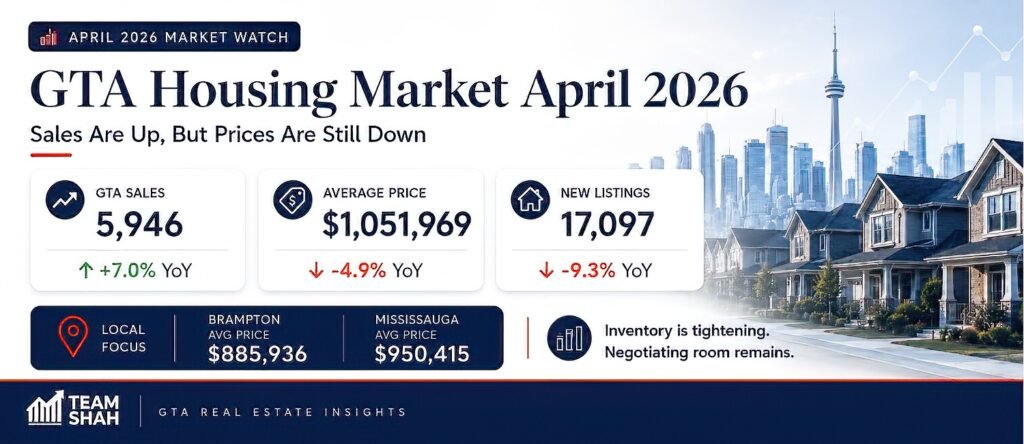
TL;DR: GTA home sales rose 7% in April 2026, but average prices fell 4.9% to $1,051,969. New listings dropped 9.3%. Buyers in Brampton and Mississauga still have real negotiating room, but inventory is starting to contract and the balance is slowly shifting.
Sales Went Up. That Is Not the Same as Prices Going Up.
In short: More homes sold in April 2026 than in April 2025, but average prices are lower than a year ago. These two facts move in opposite directions, and that gap is where buyer decisions get made.
There were 5,946 home sales through the TRREB MLS system in April 2026. That is 7% more than the 5,556 sales recorded in April 2025. Activity is unquestionably up.
The average selling price across all home types in the GTA was $1,051,969, down 4.9% from April 2025’s $1,106,505. The MLS Home Price Index Composite benchmark declined 6.6% year-over-year on an adjusted basis.
So buyers are returning to the market. Prices have not followed them upward yet. That is the honest picture in April 2026, and it is a distinction that matters for any buyer trying to plan their next move.
A buyer who hears that sales are up and assumes prices are also rising is working from the wrong starting point. If you are calibrating your offer strategy or setting your budget ceiling based on that assumption, you are making a decision on incomplete information.
| Metric | April 2026 | April 2025 | Change |
|---|---|---|---|
| Total GTA Sales | 5,946 | 5,556 | +7.0% |
| Average Selling Price | $1,051,969 | $1,106,505 | -4.9% |
| New Listings | 17,097 | 18,847 | -9.3% |
| Active Listings | 25,110 | 26,813 | -6.4% |
| MLS HPI Composite | Year-over-year | -6.6% | |
Table takeaway: Activity is rising but prices are still lower than a year ago. These two numbers moving in opposite directions is the core story for buyers in April 2026.
What Is Actually Happening with Inventory
In short: Fewer homes came to market in April. With sales rising and new listings falling, the negotiating window is starting to narrow.
There were 17,097 new listings in April 2026, down 9.3% from April 2025. At the same time, sales rose. On a seasonally adjusted month-over-month basis, TRREB noted that sales rose faster than new listings, which is an early signal of tightening, not a flooded market.
Active listings at the end of April sat at 25,110. That is more inventory than buyers faced during the 2021 and early 2022 peak years, but the direction has changed. Months of inventory for the GTA sits around 4.9 months on a trend basis, which is balanced-to-buyer territory, but not by the wide margin it showed late last year.
The pattern I keep seeing with buyers who have been sitting on the sidelines is an assumption that inventory will stay high indefinitely. The April data says otherwise. The conditions that supported maximum buyer advantage are starting to narrow. That does not mean you should rush. It means if you are genuinely ready, waiting without a plan still carries a cost.
While the GTA picture is shifting, the real story for most buyers is in what is happening in specific Peel neighbourhoods right now.
Brampton and Mississauga: What the Local Numbers Show
In short: Both cities are below the GTA average price. Brampton offers the more affordable entry point. Mississauga holds more condo and townhouse inventory, with a different opportunity in softer condo pricing.
In Brampton, the average selling price across all home types in April 2026 was $885,936. In Mississauga, the average was $950,415. Both sit below the GTA-wide average of $1,051,969. That gap is meaningful for new entrants to the Peel market who are trying to stretch a first purchase as far as possible.
In Brampton, the sales-to-new-listings ratio trend sits at approximately 30% and months of inventory is around 5.4 months on a trend basis. Those are buyers’ market conditions. Sellers are negotiating. Many buyers are still able to include financing and inspection conditions on certain properties, and seeing sellers accept reasonable adjustments rather than holding firm on list price.
For a buyer looking under $900,000 in Brampton, that means real options across townhouse and semi-detached product, time to compare, and room to negotiate. That is a materially different experience than 2021 or early 2022.
For 905 corridor buyers focused on Mississauga condos, the opportunity looks different but equally real. The average condo apartment price across the GTA was $635,653 in April 2026. Condo prices have softened more than detached prices on a year-over-year basis, which makes certain Mississauga entry points more accessible than the headline numbers suggest. More inventory, less competition, and room to be selective about building quality and maintenance fees.
What these numbers cannot tell you is whether your specific budget lines up with what is currently coming to market in the neighbourhoods you are targeting. That requires a more specific conversation, which is exactly where I start with buyers before they attend a single open house.
| Area | April 2026 Avg. | Months of Inventory (Trend) | SNLR Trend |
|---|---|---|---|
| GTA Wide | $1,051,969 | 4.9 months | 34.6% |
| Brampton | $885,936 | 5.4 months | 30.0% |
| Mississauga | $950,415 | 5.1 months | 33.2% |
Table takeaway: Both cities remain in buyer territory, but inventory contraction means the negotiating window is gradually closing.
A Quick Word on Rates
In short: The Bank of Canada target for the overnight rate is 2.25% as of April 29, 2026. Prime is 4.5%. Rates have come down from their 2023 peak, but the stress test still means you qualify at a higher rate than what your lender quotes.
The Bank of Canada target for the overnight rate as of the April 29, 2026 announcement is 2.25%. The prime rate is 4.5%. Fixed mortgage rates show one-year products around 5.49% and five-year products around 6.09%. These are materially lower than where rates sat in 2023, and they are part of why buyers are returning to the market.
What I cover in every pre-approval conversation is the gap between the rate your lender advertises and the rate you actually qualify at. Under OSFI’s B-20 mortgage stress test, you qualify at the greater of your contract rate plus 2%, or the floor rate. For example, if your lender offers 5.5%, you must still qualify at 7.5% under the stress test. That gap is where a lot of pre-approvals come in lower than buyers were expecting.
As I tell buyers, “The number your lender quotes you and the number you actually qualify at are not the same thing. Make sure you understand both before you make an offer.”
How to Read This If You Have Been Waiting on the Sidelines
In short: The price correction from 2022 is real and still present. But the conditions that created maximum buyer advantage are beginning to narrow. The right move is to prepare, not to rush or keep waiting without a plan.
The real risk is assuming today’s price correction will last indefinitely while delaying your preparation.
The correction from the 2022 peak is real. The average GTA home price peaked at $1,193,766 in 2022, according to TRREB Historic Statistics. Today it sits at $1,051,969. That is roughly a 12% reduction, even after some recovery in 2023 and 2024.
At the same time, the conditions that created maximum buyer advantage are starting to narrow. Sales are rising. New listings are falling. The balanced market of late 2023 and most of 2024 gave buyers exceptional leverage. That leverage is still present in Brampton and Mississauga right now, but it is not guaranteed to hold at its current level through the rest of 2026.
This is not a signal to rush. It is a signal to prepare. A pre-approval you can rely on, a realistic budget that accounts for closing costs, and a clear picture of which home types and neighbourhoods fit your profile are what separate buyers who move confidently from buyers who scramble.
Key Takeaways
- GTA sales rose 7% year-over-year in April 2026, but average prices fell 4.9% to $1,051,969. Sales up and prices down can coexist.
- New listings dropped 9.3% year-over-year. Inventory is contracting slowly, and the direction favours sellers over time.
- Brampton ($885,936) and Mississauga ($950,415) remain below the GTA average, making both cities accessible entry points for first-time buyers.
- Buyer advantage is still present in Peel Region, but months of inventory is starting to tighten and the window of maximum buyer leverage is starting to close.
- The stress test still requires qualifying roughly 2% above your contract rate. Understand both numbers before you make an offer.
Bottom Line
April 2026 is a market where buyers in Brampton and Mississauga still have genuine opportunity. Prices are off their peak, inventory is still relatively available, and rates are meaningfully lower than eighteen months ago. The window has not closed.
If you are looking at homes under $900,000 in Brampton, or at condo product in Mississauga, you are entering a market where you can still compare options, negotiate conditions, and take your time on the right property. That is the part worth holding onto.
What is starting to shift is the margin. The window of maximum buyer leverage is starting to close. A prepared buyer in a gradually tightening market is in a far stronger position than an unprepared one who is still watching when conditions change quickly.
The upside is that you have more negotiating room in the GTA today than you would have had in 2021 or early 2022. The trade-off is that the conditions supporting that room are showing early signs of change. The right move is not to rush. It is to stop watching and start preparing.
What This Means for You
If you are a first-time buyer looking at homes in Brampton or Mississauga right now, here is the honest translation. Prices are lower than they were two years ago, and that represents real opportunity. But inventory is contracting, and the most favourable conditions for buyers are beginning to narrow. That does not mean you should panic or rush. It means you should stop watching and start preparing. Getting your pre-approval confirmed, understanding your actual qualifying budget and not just the rate your lender advertises, and knowing which home types and neighbourhoods fit your situation puts you in a position to act confidently rather than reactively.
Frequently Asked Questions
Did GTA home prices go up or down in April 2026?
They went down. The average selling price in April 2026 was $1,051,969, which is 4.9% lower than April 2025. The MLS Home Price Index Composite benchmark declined 6.6% year-over-year. Sales volume rose 7% over the same period. Activity and price moved in opposite directions this month.
Are homes in Brampton more affordable than the GTA average?
Yes. In April 2026, the average selling price in Brampton was $885,936 across all home types, compared to the GTA average of $1,051,969. Mississauga’s average of $950,415 also sits below the GTA headline. Both cities offer meaningful entry points for first-time buyers.
Is it still a buyer’s market in the GTA?
In Brampton and Mississauga, broadly yes, but the margin is narrowing. Brampton sits at 5.4 months of inventory on a trend basis, which is buyer territory. But sales are outpacing new listings, meaning buyer leverage is slowly contracting. The window of maximum buyer leverage is starting to close.
Should I wait for prices to drop further, or buy now?
That depends on your specific financial position, timeline, and the home type you are targeting. Prices are already approximately 12% off their 2022 peak. Whether they fall further depends on rate decisions, trade conditions, and buyer demand through spring and summer. What I tell buyers consistently: the question is less about market timing and more about whether your pre-approval, savings, and budget are in position to act when the right property appears.
How does the Bank of Canada rate affect my mortgage right now?
The Bank of Canada target for the overnight rate as of April 29, 2026 is 2.25%, and the prime rate is 4.5%. Lenders set variable-rate products based on prime. Fixed rates are set by bond markets and are not directly tied to the overnight rate. Regardless of which product you choose, the mortgage stress test requires you to qualify at your contract rate plus 2%. Your actual qualifying rate is higher than what your lender advertises.
What should I do before viewing homes in this market?
Three things, in this order. First, get a pre-approval confirmed from a lender, not just a prequalification estimate. Second, build a full closing cost budget that includes land transfer tax, legal fees, title insurance, and any adjustments. Third, define your must-haves versus nice-to-haves before you walk into an open house, so you are comparing properties against your own criteria rather than reacting to presentation. Buyers who do this before they start viewing are far less likely to be caught off guard.
Ready to Know What April’s Market Means for Your Budget?
You now know that prices are lower than a year ago, that inventory is starting to contract, and that the stress test will qualify you at a rate higher than what your lender quotes. The missing piece is your specific number: what you actually qualify for, what your negotiating room looks like against current Brampton and Mississauga inventory, and whether now makes sense for your situation.
That is the conversation I can help with. I will compare your budget against what is actually available, explain what your negotiating position looks like in the areas you are targeting, and help you decide whether it makes sense to act now or keep a watchful eye on the market.
Gaurang Shah | Royal LePage Flower City Realty
647-892-2411 · mail@myshahteam.com · www.myshahteam.com
Consultations are available in English, Hindi, Gujarati, Marathi, and Punjabi.
References
- Toronto Regional Real Estate Board. Market Watch, April 2026. Released May 5, 2026. All sales, listing, price, and inventory data in this article: trreb.ca
- Toronto Regional Real Estate Board. Historic Statistics. Annual TRREB MLS Sales and Average Price 1980 to 2025: trreb.ca
- Bank of Canada. Target for the overnight rate: 2.25%. Announcement date: April 29, 2026. Next scheduled announcement: June 4, 2026: bankofcanada.ca
- Office of the Superintendent of Financial Institutions (OSFI). Residential Mortgage Underwriting Practices and Procedures. Guideline B-20. Stress test qualifying rate framework: osfi-bsif.gc.ca