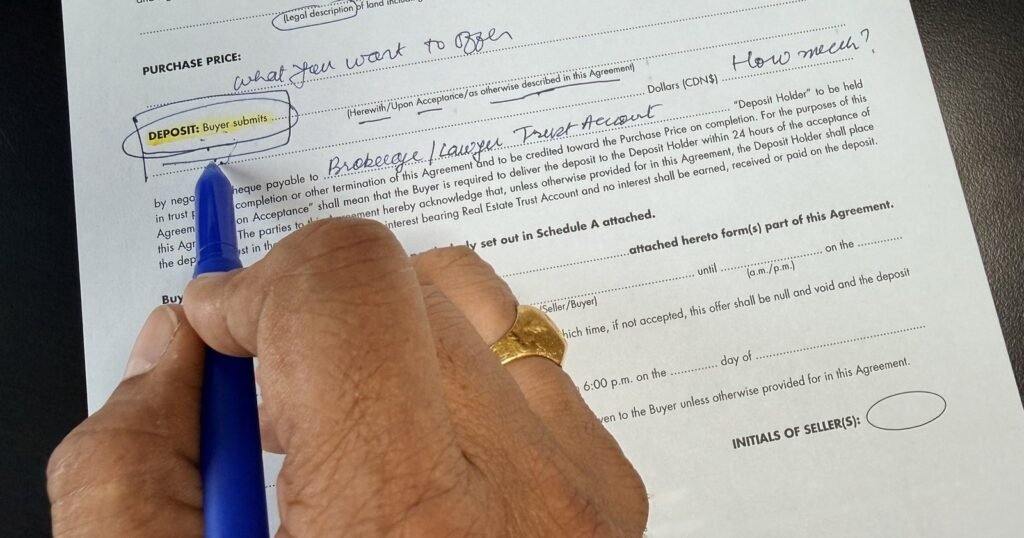
I was explaining the deposit during a buyer consultation when the buyer stopped me. “But what if I have a firm deal and I just don’t bring in the deposit?” It was an honest question. The buyer believed the deposit was what made the agreement binding. No deposit, no deal. That belief is understandable. It can also become an expensive mistake.
Here’s the short answer. No. In Ontario, not delivering the deposit does not automatically cancel an accepted Agreement of Purchase and Sale. What happens next depends on the agreement and the facts, and a buyer in that position should speak with a real estate lawyer right away.
If you’ve already signed and you’re feeling a knot in your stomach, you’re not alone. Second thoughts after an accepted offer are common. Asking the question is the smart move. Quietly acting on the wrong answer is the risky one.
Who This Is ForBuyers in Brampton, Mississauga, and across the GTA who have signed an offer, or are about to. First-time buyers and newcomers who assumed the deposit is what makes a deal real. And sellers waiting on a deposit that hasn’t shown up.
Quick AnswerDoes not paying the deposit cancel an Ontario real estate deal? No, not automatically. RECO, Ontario’s real estate regulator, says entering into an agreement is binding and that not delivering the deposit does not automatically mean the deal is cancelled or nullified. In Tallman v. Miller, 2026 ONSC 77, the Ontario Superior Court of Justice rejected a buyer’s argument that her agreement wasn’t binding because she never paid the deposit.
Last ReviewedSeptember 2026. Based on RECO guidance and an Ontario Superior Court of Justice decision available at the time of writing. Confirm your own situation with an Ontario real estate lawyer.
Why “No Deposit, No Deal” Feels True
It makes sense on the surface. In everyday life, paying is usually what makes something official. Buyers who have purchased property in other countries may also have learned a different order of things.
In Ontario, it works the other way around. When your offer is accepted, a binding Agreement of Purchase and Sale can be formed right then. Inside it, you made promises: to deliver a deposit by a deadline, often “upon acceptance,” which many agreements define as within 24 hours, and to close on a set date. In the GTA, the deposit is commonly held in trust by the listing brokerage and credited toward the price on closing.
So the deposit doesn’t create the agreement. It’s one of the obligations the agreement creates.
RECO puts it more formally. In a Legal Corner article on deposits, it said agents should advise clients that “entering into an agreement is binding and not delivering the deposit does not automatically mean a deal is cancelled or nullified.”
Some agreements include specific wording about late or missing deposits. What that wording means for you is a question for your lawyer.
What Happened When One Buyer Tried It
Early in 2026, the Ontario Superior Court of Justice decided a case that shows how this plays out: Tallman v. Miller, 2026 ONSC 77.
A buyer agreed to purchase a Vaughan home for $5,420,000, with no financing condition. The agreement required a $280,000 deposit within 24 hours. It never arrived.
The parties signed several amendments extending the deposit deadline and the closing date, which moved from December 15, 2023 to February 29, 2024. According to the sellers, they agreed because they kept being told the buyer’s funds were on the way. The deposit never came, and the deal never closed.
The buyer’s position was that she had always understood the deal “died” unless a deposit was made, so the agreement wasn’t binding. The court disagreed. It pointed to earlier cases where courts found a binding contract even though the deposit was never paid, found the buyer had breached the agreement, and awarded the sellers $1,625,733.15 for the drop in the home’s value and their carrying costs, plus interest and legal costs.
Two things to keep in perspective. The buyer never filed a defence, so the court treated the sellers’ facts as admitted, and a contested case could look different. And while the same legal issue can arise with a Brampton townhouse, a Mississauga condo, or any other Ontario property, the result still depends on the agreement and the facts.
What stands out to me is how ordinary each step looked. An extension here, another there. Repeated extensions can make the problem larger if the underlying issue hasn’t been resolved.
So What Can Actually Get You Out?
There are real ways a deal can end. Deciding you’re out isn’t one of them, and neither is going quiet.
If your offer had a condition, like financing or a home inspection, what happens when it isn’t met depends on exactly how it was written. Both sides can agree in writing to end the deal through a mutual release. Some agreements contain other termination rights. And if the parties can’t agree, a court may ultimately decide.
A firm offer may look more attractive to a seller, especially when several buyers are competing. But removing conditions also removes protections you might need later.
If a deposit was already paid and the deal falls apart, the money doesn’t simply go back to whoever asks first. RECO explains that a brokerage can release a deposit from a failed deal when both the buyer and seller sign an agreement about it, or when a court orders it, with limited exceptions.
And if a buyer doesn’t close a binding deal, the seller may treat it as a breach, resell, and claim losses such as a drop in value, carrying costs, interest, and legal costs, depending on the facts and what a court decides.
Signed and Second-Guessing?Call before the deadline, not after. We can help you review the transaction timeline, gather the relevant documents, and connect with your real estate lawyer. Only your lawyer can advise you on your legal position.
Two Phone Calls, Two Very Different Weeks
Here’s a composite example, not a real client, to show why timing matters.
A young couple buys their first home in Brampton, a semi for $950,000, firm, with a $50,000 deposit due within 24 hours. The next morning, one of them learns their contract role is ending. The deposit suddenly feels impossible.
The Quiet Version
They don’t send the deposit and stop answering calls because they don’t know what to say. The deadline passes. A few days later, a letter arrives from the seller’s lawyer. Every option is now harder.
The Early-Call Version
Before the deadline, they call their agent. By noon they’re speaking with a real estate lawyer who has read the full agreement. Now there are real conversations to have, about a written extension, a possible mutual release, or what their risk actually looks like.
Nobody can promise how the second version ends. But that couple has more options on Friday.
Silence doesn’t cancel a deal. It just takes you out of the conversation about how it ends.
If you’re in the first half of that story, here’s the order I’d follow:
- 1. Call your real estate lawyer, before the deposit deadline if you still can.
- 2. Tell your real estate representative right away.
- 3. Don’t assume non-payment cancels anything.
- 4. Gather the full agreement, including every schedule, condition, and amendment.
- 5. Don’t sign an amendment or release until someone has explained what it does.
- 6. Get legal advice before telling the other side you’re backing out.
The Better Version Starts Before You Sign
Before we write any firm offer, I want the deposit ready to move: the money in an account you can reach quickly, your bank’s draft or transfer limits known, and the deadline understood in hours, not “soon.” You don’t need to rush into a firm offer. You do need to know your deposit can arrive on time if you make one. If this is your first purchase, our first-time home buyer guide for Brampton walks through the rest of the process.
If You’re the Seller Waiting on a Deposit
Waiting on a deposit that isn’t coming is stressful. Your listing representative should tell you promptly if it hasn’t arrived. Speak with your own real estate lawyer before deciding anything, and don’t assume you can freely relist or accept another offer until you understand where you stand. Keep a record of every message, extension, and deadline. A missing deposit can feel like the deal is over. Legally, it may not be.
The Bottom Line
Second thoughts after signing are human. The mistake isn’t the doubt. It’s treating the deposit as an exit and acting on that without advice.
The deposit is not the door into the deal. It’s a promise you made once you were already inside.
Buying Soon? Know Every Deadline Before You SignBefore your next offer, let’s walk through your deposit, your conditions, and your deadlines together, so nothing in the agreement surprises you. Start with our Buyer’s Guide, then reach out when you’re ready.
Frequently Asked Questions
Does not paying the deposit cancel a real estate deal in Ontario?
Not automatically. RECO says that not delivering the deposit does not automatically mean a deal is cancelled or nullified. Depending on the agreement, it can be treated as a breach by the buyer. Speak with a real estate lawyer right away.
Is a real estate agreement binding before the deposit is paid?
It can be. Once an offer is accepted according to its terms, the Agreement of Purchase and Sale can be binding even if the deposit hasn’t arrived. The deposit is usually one of the buyer’s obligations under the agreement, not the thing that creates it.
What happens if the buyer misses the deposit deadline?
It depends on the wording of the agreement and what the parties do next. The seller may treat it as a breach, or both sides may agree in writing to extend the deadline. A missed deadline does not, by itself, release the buyer.
Can a seller sue a buyer who does not close?
A seller can start a claim. Whether they recover damages, and how much, depends on the agreement, the seller’s actual losses, and what a court decides. In Tallman v. Miller, an undefended case, the court found the buyer in breach and awarded the sellers the drop in market value plus carrying costs, interest, and legal costs.
Can a buyer get a deposit back after signing a firm deal?
Sometimes, but not simply by asking. A deposit may be returned under the terms of the agreement, through a mutual release both sides sign, or by court order. If the buyer is the one who failed to complete, the seller may have a claim to it. Ask your lawyer.
Who decides whether a deposit held in trust is released?
Not the brokerage on its own. RECO explains that a brokerage can release a deposit from a failed deal when both the buyer and seller sign an agreement about the release, or when a court orders it, with limited exceptions.
This article provides general information about Ontario real estate transactions and is not legal advice. Every Agreement of Purchase and Sale is different. Buyers and sellers facing a deposit or closing dispute should obtain advice from an Ontario real estate lawyer.
References
- 1. Real Estate Council of Ontario (RECO), Legal corner: Deposits play an important role in a real estate transaction, December 12, 2023.
- 2. Real Estate Council of Ontario (RECO), I bought a house, but the deal didn’t close. What happens to my deposit being held by the listing brokerage?
- 3. Ontario Superior Court of Justice, Tallman v. Miller, 2026 ONSC 77, released January 5, 2026.