
By Gaurang Shah
Every condo buyer thinks the scary part of a status certificate is the reserve fund. I have sat across from enough of them to tell you the part that actually catches people is smaller, quieter, and buried a few pages in, a single line about Section 98 agreements. Most buyers read straight past it. The ones who do not are the ones who avoid the worst surprises.
A GTA resale condo or condo-townhouse buyer whose lawyer has flagged something in the status certificate, an alteration, a missing agreement, or a question about what the condo corporation actually approved before deciding whether to waive the condition.
Do not waive the condition until you know which problem you are actually looking at. A status certificate that says the unit is not subject to a Section 98 agreement is not the same as a status certificate that says nothing has ever been changed. One is a fact about paperwork. The other is a fact about the unit. My read: a quiet status certificate is not automatically a clean one. Find out which kind you have before you decide anything.
The Condominium Act and Condominium Authority of Ontario guidance below reflect current rules as of this writing. Condo law, case outcomes, and status certificate practices can shift. Confirm specifics with a real estate lawyer before waiving your status certificate condition.
What a Section 98 Agreement Usually Addresses
Here is the assumption that gets buyers in trouble: if something has been there a while, it must be fine. A patio enclosure, a custom door, a parking pad extension, if it looks original and nobody has said anything, most people assume somebody, somewhere, signed off on it. Ontario’s Condominium Act does not work that way.
Under Section 98 of the Condominium Act, 1998, an owner can make an addition, alteration, or improvement to the common elements, including the parts assigned for their exclusive use, but only after the board approves it and both sides sign a written agreement. That agreement then gets registered on title. Once it is registered, it does not just bind the person who made the change. It binds every owner who comes after them, including you, if you are the one buying the unit. That is the entire mechanism, and it matters less to you than what happens when it gets skipped, which is where the rest of this article lives.
How the Problem Appears in a Status Certificate
This is where the status certificate comes in, and where the real gap opens up. The certificate will state whether the unit is subject to one of these registered agreements. Ask any condo lawyer, and they will tell you the honest answer, in most cases, comes back no.
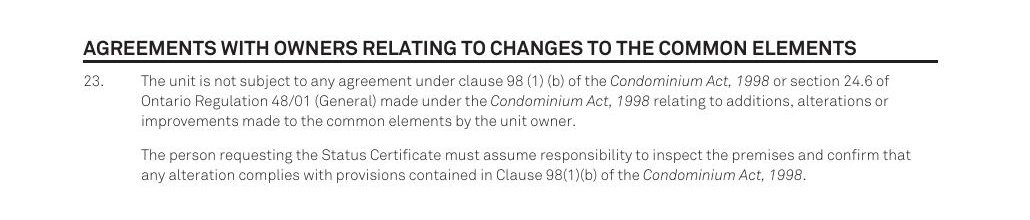
Here is what that no actually means, and what it does not. It confirms nothing was ever registered. It does not confirm nothing was ever changed. A condo lawyer who has walked through this exact scenario put it plainly: the certificate can say the unit is not subject to an agreement, and the buyer can still close, move in, and get a complaint months later about an alteration the corporation never actually approved.
And the accuracy cuts both ways. The Condominium Authority of Ontario has flagged that whatever a status certificate includes, or leaves out, binds the corporation to it. A recent Superior Court decision let an owner off the hook for a special assessment specifically because the certificate never clearly disclosed it. This document is doing more legal work than most buyers give it credit for.
What Most Condo Buyers Get Wrong
My read, after enough of these conversations: buyers treat a clean-looking status certificate as proof the unit is problem-free. It is proof of something narrower, that nothing was ever formally registered. Those are not the same fact, and the space between them is exactly where the surprises live.
The second mistake is bigger, and harder to see coming. Buyers assume informal awareness is the same as approval. If the property manager has known about a balcony enclosure for six years and never said a word, that feels like permission. It is not. It is silence, and silence is not a board resolution. Courts have sided with owners when a corporation waited too long to object to something visible and long-standing. They have also sided with corporations when the change was recent and nobody disclosed it. Which side you land on depends entirely on the specific facts in front of you, not on how comfortable the silence has felt so far.
Who Is Responsible for Fixing the Problem?
Nobody hands you a single name here, and that is the honest answer, not an evasive one.
Start with the seller. They may need to finish a registration that was never completed, or they may genuinely have no idea a problem exists, plenty of sellers inherited the alteration from someone before them. Either way, fixing it is not automatically their job unless your agreement of purchase and sale says so in writing.
Then there is the condo corporation, which holds more leverage than most buyers realize. It can require the current owner to formally register the change after the fact, or it can require the alteration removed and the common element restored, at the owner’s expense. But leverage is not the same as an automatic win. A recent Ontario Superior Court decision refused to order removal of a concrete pad that had sat there, in plain view, for decades. The corporation knew. It did nothing. The court decided that mattered.
Which brings you to the part that actually protects you: your lawyer and your realtor, working together before closing, not after. Your lawyer reviews the status certificate for exactly this gap. Your realtor can push to get a seller covenant written into the agreement of purchase and sale, a plain statement that no unapproved alterations exist. It will not catch everything. But it hands you a contractual remedy if something turns up six months from now instead of leaving you to argue about who should have known what.
Proceed, Extend, Renegotiate or Walk Away?
Once you know what you are actually dealing with, the decision usually sorts itself into one of four lanes.
| Path | What It Means | Best When |
|---|---|---|
| Proceed | Waive the condition and close as planned | The status certificate shows a registered agreement, or no alteration exists at all |
| Extend the condition | Give your lawyer more time to confirm what actually exists | Information is incomplete but likely resolvable within a few extra days |
| Renegotiate | Ask the seller to complete registration, provide a credit, or hold back funds at closing | A real issue exists and the seller is willing to address it |
| Walk away | Exit under the status certificate condition | The corporation flags a likely removal or restoration order, or the seller will not cooperate |
The upside of extending the condition a few extra days is that you get an actual answer instead of a guess. The trade-off is that it can cost you the deal if the seller has other offers waiting. Know which risk you are more willing to carry before you ask for the extension.
An extension is not automatic, and it is worth knowing what you are actually asking for before you ask for it. The seller has to agree to amend the closing conditions. They are not obligated to say yes, and a seller with other interested buyers may not want to. If your mortgage rate hold has an expiry date, check whether even a short extension pushes you past it, re-locking a rate is a separate conversation with your lender, not something that happens automatically alongside a real estate extension. Your deposit is not at risk during any of this either way, it sits in a lawyer’s or brokerage’s trust account regardless of how long the condition period runs. What genuinely changes is leverage. Asking for more time can signal to a seller that something is wrong, and a seller who was flexible on other points may become less so once they sense hesitation.
A Mississauga Condo-Townhouse Scenario
Here is a shape I see often, not one specific transaction, but a pattern I have watched repeat across Mississauga condo-townhouse complexes more than once. A buyer falls for a unit in Erin Mills with a fenced-in patio extension that looks original to the building. The status certificate comes back showing no Section 98 agreement on file. The listing agent assumes that means the patio was pre-approved by the builder and never questions it further. It is exactly this assumption, builder-installed must mean approved, that a lawyer needs to test before the condition is waived, not after. If carrying costs are also part of your decision, our Condo Maintenance Fees guide covers the monthly side of that math.
If your status certificate has raised a question you cannot fully answer yet, book a 15-minute call and we will walk through what it actually says, and what it does not, before you decide. No pressure, no pitch, just the facts in front of you.
Checklist Before Waiving the Status-Certificate Condition
Before you tell your lawyer to waive anything, run this list first.
- Confirm the exact wording on that disclosure question, do not just skim past it.
- Ask the property manager directly whether any known unregistered alterations exist on the unit.
- Walk the unit and any exclusive-use common elements, balcony, patio, parking pad, for visible changes.
- If one of these agreements does exist, confirm with your lawyer that it is actually registered on title, not just referenced in a letter.
- Ask how long any visible alteration has existed and whether the corporation ever raised it before.
- Confirm whether your agreement of purchase and sale includes a seller covenant about unapproved alterations.
- Get your lawyer’s read in writing before the condition deadline, not a verbal comment the day of.
Bottom Line
A relisting is a signal, and so is a quiet status certificate, neither one is a verdict on its own. A clean answer on that question tells you what was never registered. It does not tell you what was never built. Get the actual answer before you waive the condition, not after.
Frequently Asked Questions
What is a Section 98 agreement in an Ontario condo?
It is a written agreement between a unit owner and the condo corporation that approves an addition, alteration, or improvement to the common elements, including elements for that owner’s exclusive use. Once registered on title, it binds all future owners of the unit.
Can I buy a condo with unapproved renovations?
You can, but the risk depends on what the renovation is, how long it has existed, and whether the corporation ever raised it. Some buyers proceed with a clear-eyed understanding of the risk. Others negotiate a fix or a credit first. A lawyer’s review before waiving the condition is what makes that a decision rather than a guess.
Who must correct an unregistered condo alteration?
There is no single automatic answer. The condo corporation may require the current owner to formally register the change after the fact, or require the alteration removed and the area restored. Courts have sometimes limited a corporation’s ability to force removal of long-standing, openly visible changes.
Can a Section 98 issue delay closing?
It can, particularly if your lawyer needs more time to confirm what actually exists. Extending the status certificate condition by a few days is common when the certificate raises a question rather than a clear answer.
Can a condo board require renovations to be reversed?
In some circumstances, yes. Boards have successfully required removal of unapproved alterations. Courts have also declined to order removal where a corporation knew about a change for years and did nothing. The outcome depends heavily on the specific facts, not on a fixed rule.
Reviewing a status certificate with a real question mark in it? We will go through it together before your condition deadline. For the full GTA buying process, see our GTA Buyer’s Guide.
References
Condominium Act, 1998, S.O. 1998, c. 19, Section 98: canlii.org
O. Reg. 48/01 (General) made under the Condominium Act, 1998: ontario.ca
Condominium Authority of Ontario, What Is a Status Certificate: condoauthorityontario.ca
Condominium Authority of Ontario, Status Certificates: condoauthorityontario.ca
Isenberg and Shuman, Section 98 of the Condominium Act, Its Importance for Buyers and Sellers: shumanlaw.ca
Lash Condo Law, Court Refuses to Order Removal of Longstanding Common Element Addition: lashcondolaw.com
